
What "Mara Serengeti" actually means
Type Mara Serengeti into a search bar and you will find two overlapping ideas. The first is the Mara River region of the northern Serengeti in Tanzania — the stage for the famous river crossings between July and October. The second is the wider Serengeti–Masai Mara ecosystem, a single unbroken sweep of grassland shared by Tanzania and Kenya, through which nearly two million wildebeest and zebra move every year. This article untangles both: the geography, the crossings themselves, why the Tanzanian side of the river offers such remarkable access, and how to build a safari around it.
We should say at the outset what this guide is not. It is not a month-by-month account of the whole migration — we have covered that in detail elsewhere. This is specifically about the Mara River country: the northern Serengeti around Kogatende and the Lamai Wedge, the ecosystem it belongs to, and the honest comparison between watching the drama from the Serengeti side and from the Masai Mara side. As a Tanzanian operator based in Arusha, Sokwe Africa Safaris has been sending travellers to this river for years, and it remains, in our view, the single most dramatic wildlife theatre in Africa.
One ecosystem, two countries
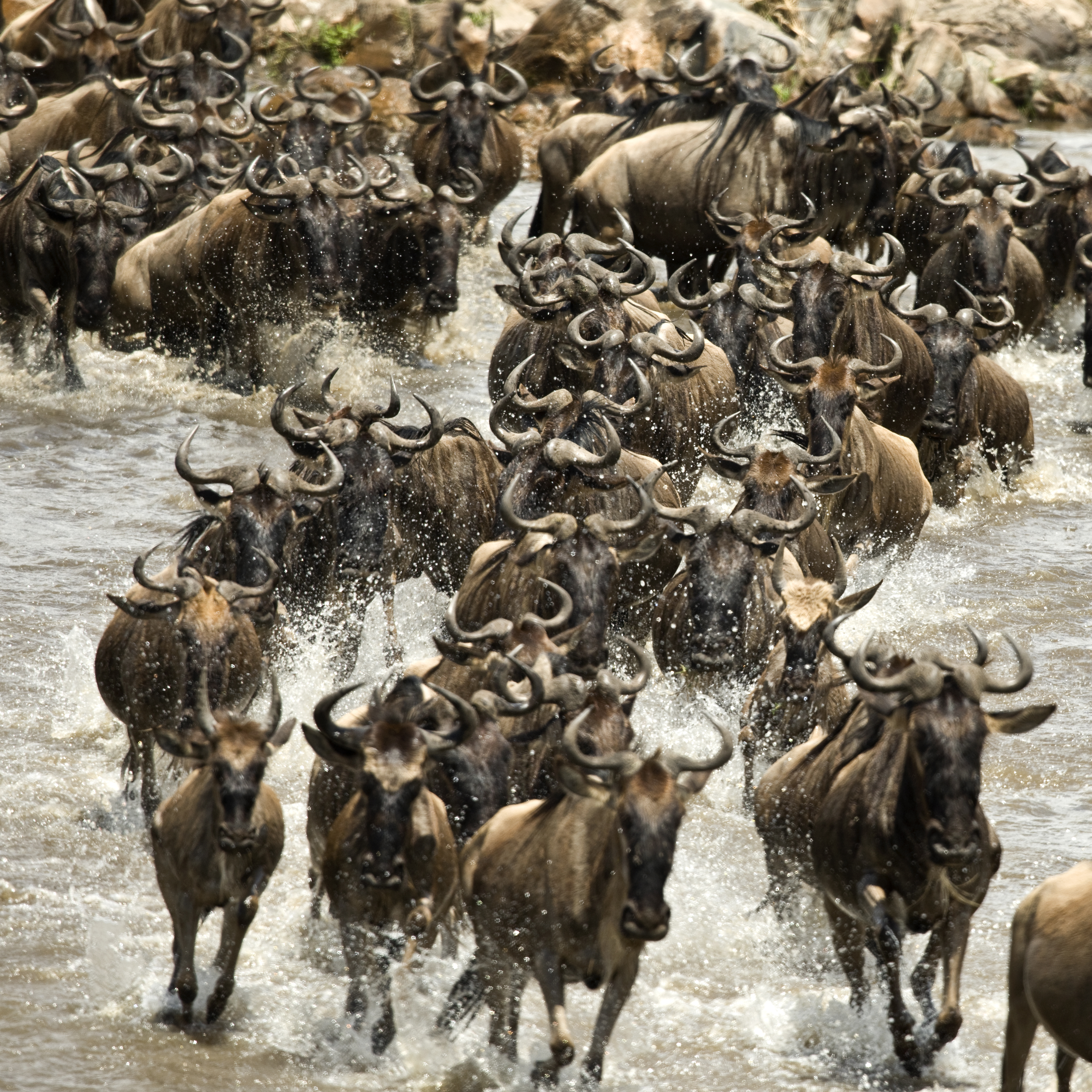
The Serengeti–Mara ecosystem covers roughly 30,000 square kilometres, and the animals that define it have never read a map. The Serengeti National Park in Tanzania makes up the great majority of the ecosystem — around 25,000 square kilometres including the adjoining reserves — while Kenya's Masai Mara National Reserve and its surrounding conservancies account for perhaps a tenth of the total area. The border between the two countries runs invisibly through the grass; the wildebeest cross it twice a year without ceremony, following the rains as they have for millennia.
This matters for planning, because it corrects a common misconception: that the migration "lives" in the Masai Mara and merely visits the Serengeti. The reverse is closer to the truth. The herds spend eight to nine months of the year on Tanzanian soil, calving in the south around February, sweeping north through the western and central Serengeti, and massing along the Mara River from July. Only a portion of the herds pushes over the border into Kenya at the height of the dry season, and even then, enormous numbers remain in the northern Serengeti throughout.
The Mara River: the stage for the drama
The Mara River rises in Kenya's Mau highlands and snakes south-west through the Masai Mara before crossing into Tanzania and cutting through the northern Serengeti on its way to Lake Victoria. It is the only permanent river in the northern reaches of the ecosystem, and in the dry season it becomes both a lifeline and a barrier. The grazing the herds need lies on both banks at different times, so the wildebeest must cross — and cross again — through water patrolled by some of the largest crocodiles in Africa.
The river itself is a character worth knowing. In most crossing places it runs perhaps forty to eighty metres wide, brown and deceptively quick, between steep banks pocked with hippo trails. There are dozens of traditional crossing points on the Tanzanian side, each with its own personality — some wide and shallow where crossings flow smoothly, others narrow and brutal where the banks funnel thousands of animals into chaos. Good guides know these points by number and by habit, and reading which one the herds will choose is a skill that separates a fine crossing day from a long, hot wait.
What actually happens at a crossing
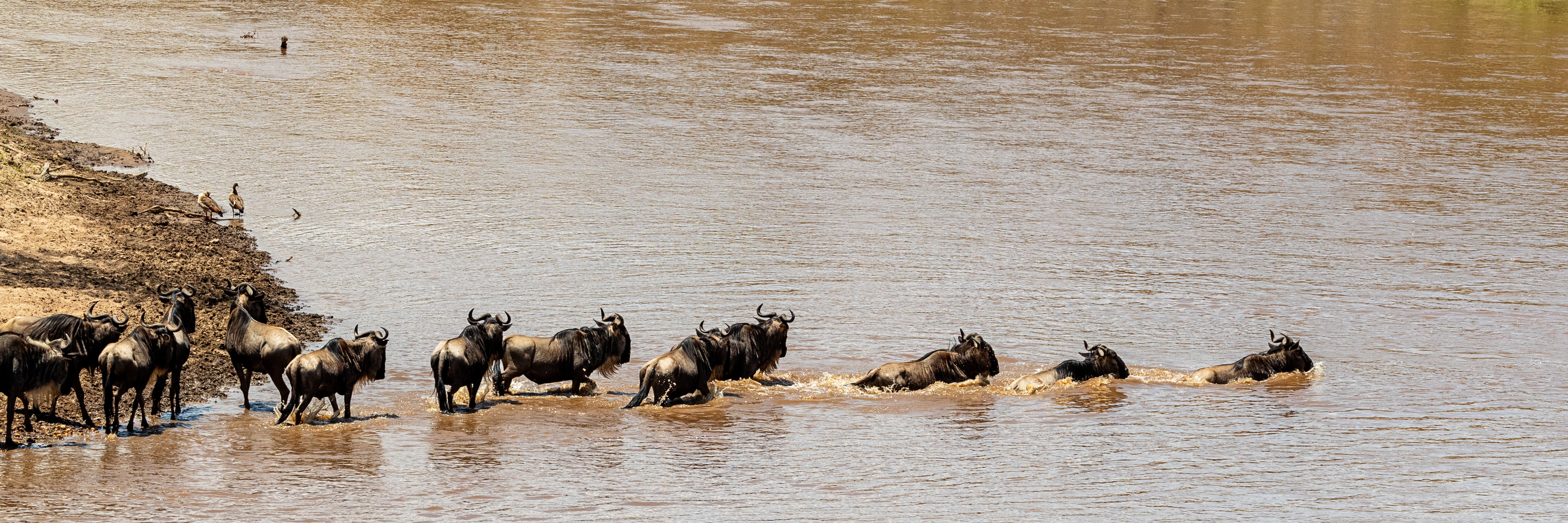
A river crossing is not a scheduled event, and that is precisely its power. The herds build up on one bank, sometimes for hours, sometimes for days — grazing, massing, edging towards the water and shying away again. The tension is extraordinary. Then something unknowable tips the balance: one animal commits, and suddenly thousands follow, pouring down the bank in a cascade of dust and noise, leaping into the current while crocodiles move in and the far bank becomes a scramble of hooves. It can last twenty minutes or two hours, and no two crossings are alike.
Crossing season on the Mara River runs from roughly July to October, with the most consistent action typically between mid-July and September. During these months the herds cross back and forth repeatedly — this is not a single one-way event but a restless shuttling between the grazing on either side, driven by scattered rain and the smell of fresh grass. That is why basing yourself near the river for three or four nights gives you a genuinely strong chance of witnessing at least one crossing, and often several. For the wider timing picture across the year, see our guide on when to see the migration.
Kogatende and the northern Serengeti
The heart of the action on the Tanzanian side is Kogatende, the area around the airstrip of the same name on the southern bank of the Mara River. From here, a network of game-viewing tracks follows the river east and west past the numbered crossing points, and the country rolling away from the water — open grassland broken by kopjes and pockets of woodland — is classic northern Serengeti at its loveliest. Across the river lies the Lamai Wedge, the triangle of land between the Mara and the Kenyan border, reachable by a bridge crossing and superb when the herds are on the northern bank.
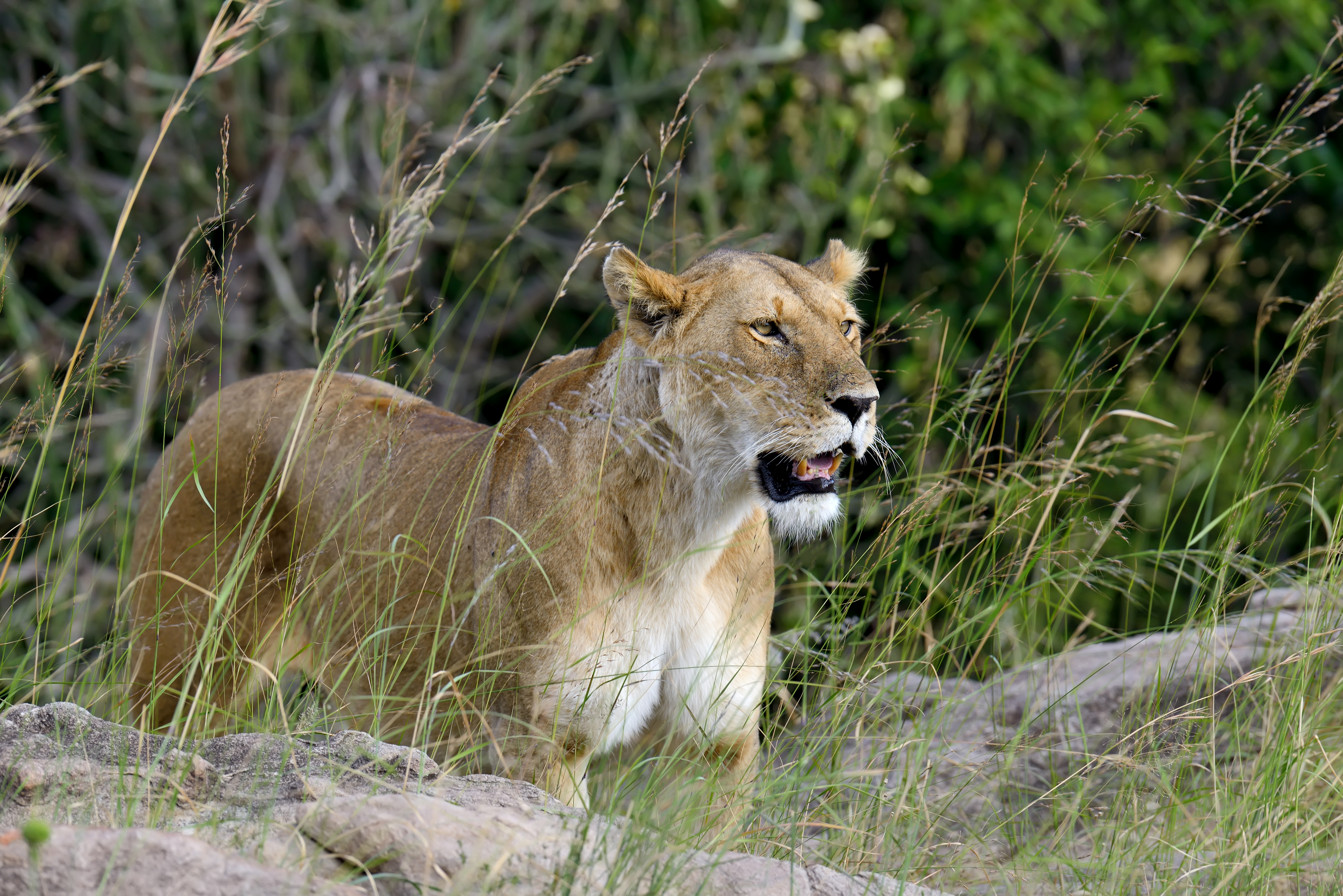
What surprises many first-time visitors is how good the resident game is here, quite apart from the migration. The northern Serengeti supports strong prides of lion, excellent leopard along the river lines, elephant in numbers that have grown steadily over the past decade, and a genuine chance of black rhino in the Lamai area. Even if you arrived in a quiet week between crossings, you would still be in one of the finest game-viewing landscapes in Tanzania — the crossings are the headline, but they are far from the whole show.
Why the Tanzanian side gives better access
Here is the honest, practical case for watching the Mara River drama from the Serengeti side. The Tanzanian bank has far more river frontage inside the protected area — the great majority of the Mara River's course through the ecosystem, and the majority of the traditional crossing points, lie within the Serengeti National Park. More river means more crossings to find and more room to spread out, and the northern Serengeti's remoteness keeps vehicle numbers a fraction of what the compact, heavily lodged Masai Mara sees at the same crossings in the same season.
The difference on the ground is real. At a busy Mara-side crossing in Kenya in August it is not unusual to share the spectacle with dozens of vehicles jostling for position; at Kogatende you will often watch with a handful of other cars, and sometimes none at all. Park rules on the Tanzanian side are firmly enforced, guides give the animals room to commit to the water, and the whole experience feels wilder and less managed. None of this diminishes the Masai Mara, which is a magnificent reserve — but for the crossings specifically, the northern Serengeti is the connoisseur's choice.
Camps in the northern Serengeti
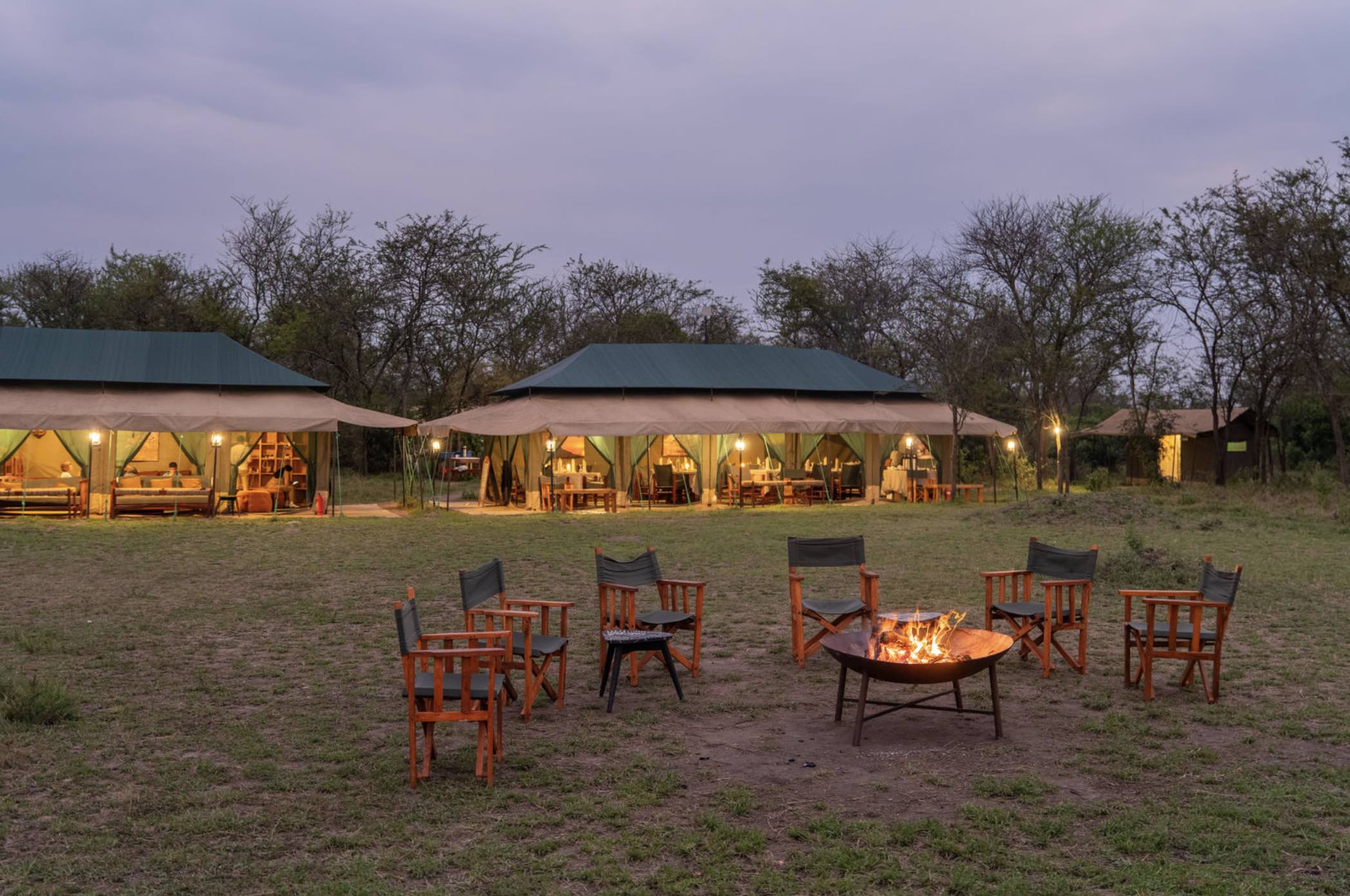
Accommodation in the north splits into two broad styles. The first is the seasonal or mobile camp: intimate tented camps of eight to twelve tents that set up within striking distance of the river for the crossing months, offering an authentic, canvas-and-lantern safari with excellent guiding and honest comfort. The second is the small permanent lodge or camp, of which the north has a handful — more polished, open year-round, and often beautifully sited on kopjes or river bends. Both styles put you within thirty to sixty minutes of the main crossing points, which is what matters most in crossing season.
Expect northern Serengeti camps in migration season to cost more than their central Serengeti equivalents — roughly 700 to 1,200 US dollars per person per night for quality tented camps in 2026, and upwards of 1,500 for the top lodges, typically inclusive of meals, drinks and game drives. Demand is intense: July to September in the north is the single most sought-after booking in Tanzania, and the best camps fill nine to twelve months ahead. If a Mara River safari is the dream, it rewards being the first thing you plan, not the last.
Combining the north with the central Serengeti
The strongest northern itineraries pair Kogatende with the central Serengeti around Seronera. The centre is the ecosystem's year-round engine room — resident big cats in remarkable density, the famous leopard territory along the Seronera River, and superb general game whatever the month. Three nights in the centre followed by three in the north gives you the best of both: reliable predator viewing and classic Serengeti scenery first, then the river and the crossings as the crescendo. The drive between the two takes around four to five hours with game viewing along the way, or you can hop between airstrips in forty minutes.
Most travellers frame the whole trip around the northern circuit: fly into Kilimanjaro, take in Tarangire or Lake Manyara and the Ngorongoro Crater, then work up through the Serengeti to Kogatende and fly out from there back to Arusha. Nine to eleven days does this beautifully without rushing. Sokwe builds these routes daily in migration season, sequencing the camps so the crossings come last — after the crater and the central plains, the river is the finale the trip has been building towards. Browse our safari packages for itineraries built exactly this way.
Serengeti or Masai Mara: an honest comparison
Travellers regularly ask us to compare the two sides, and the honest answer depends on what you want. The Masai Mara is smaller, more accessible from Nairobi, marginally cheaper to reach, and its private conservancies offer wonderful off-vehicle experiences such as night drives and walking. Its game density year-round is superb. The trade-offs are crowds at the famous crossings, a shorter window when the herds are present — roughly August to October — and a reserve compact enough that solitude is hard to find in high season.
The Serengeti offers scale, wildness and time. The herds are on Tanzanian soil most of the year, the northern crossings run from July, vehicle pressure is lower, and the same trip naturally folds in the Ngorongoro Crater — arguably Africa's single richest game-viewing arena — and the rest of the northern circuit. If you can only do one side, and the river crossings are your priority, we believe the northern Serengeti is the stronger choice. If you have the time and budget for both, a combined Kenya and Tanzania safari lets you follow the ecosystem across the border and judge for yourself.
The wildebeest have never read a map. The river they cross is the same river; the question is simply which bank you would rather stand on — and how many vehicles you are willing to share it with.
Practical planning for a Mara River safari
A few practicalities will save you disappointment. First, be patient about the crossings themselves: they cannot be scheduled, and a good guide will position you well and wait rather than chase rumours up and down the river. Build at least three nights near Kogatende into the plan. Second, fly rather than drive if time is short — daily scheduled flights link Kogatende with Arusha, the central Serengeti and Zanzibar, turning a full day's drive into under an hour. Third, book early; we cannot overstate how quickly July to September sells out in the north.
Budget-wise, a well-built northern Serengeti crossing safari of seven to nine days typically lands between 4,500 and 8,000 US dollars per person in 2026 at mid-to-upper tented level, with luxury versions beyond that — park fees, flights and quality camps in peak season are the drivers. Shoulder weeks in early July and October offer meaningfully better value with very real crossing chances. For the full context of how the river season fits into the annual cycle, our great migration safari guide covers the whole year in depth.
- Crossing season at the Mara River: July to October
- Base: Kogatende and the Lamai Wedge, northern Serengeti
- Stay at least three nights near the river
- Most crossing points lie on the Tanzanian side
- Far fewer vehicles than the Masai Mara at peak
- Book the north nine to twelve months ahead
Beyond the crossings: the north out of season
It is worth knowing that the Mara Serengeti region does not switch off when the herds move on. From November to June the north becomes one of the quietest, most beautiful corners of the park — resident game remains strong, the river still draws elephant, giraffe and big cats, and the handful of permanent camps drop their rates considerably. Photographers in particular love the north in the green months, when the light is dramatic and you may not see another vehicle all day. It is a different experience from crossing season, but a deeply rewarding one.
The out-of-season north also solves a problem for travellers whose dates simply cannot match the crossings. Rather than forcing a July trip that does not fit, a well-designed safari follows the herds wherever they actually are — the calving grounds in February, the western corridor in June — and adds the north for its landscapes and solitude. The migration is a twelve-month story, and the Mara River chapter, thrilling as it is, is only one part of it. An honest operator will always fit the itinerary to your dates, not the other way round.
Stand on the banks of the Mara in crossing season
There are wildlife spectacles you tick off, and there are those that recalibrate what you thought the natural world could do. Watching several thousand wildebeest hurl themselves into the Mara River — dust rising, crocodiles moving, the far bank boiling with animals — belongs firmly in the second category, and the northern Serengeti remains the finest place on earth to witness it. With the right camp, the right guide and enough nights by the river, the odds are strongly in your favour.
Want to stand on the banks of the Mara in crossing season? Tell us your dates. Sokwe Africa Safaris is based in Arusha, we know the Kogatende crossing points and the northern camps first-hand, and we will build you a Serengeti safari that puts you by the river when it matters — and books it before the north sells out. Get in touch through our contact page and let us start planning your Mara Serengeti safari today.
Plan your Mara Serengeti safari with Sokwe Africa Safaris